Friday, May 13, 2011

BRIDESMAIDS


Written by Kristen Wiig and Annie Mumolo
Directed by Paul Feig
Starring Kriten Wiig, Maya Rudolph, Rose Byrne, Melissa McCarthy, Chris O'Dowd and Jon Hamm

Megan: You're your problem and you're also your solution.

For years now, the boys have been yukking it up at the movies for our enjoyment and they have been doing it as crassly as humanly possible. These male bonding pictures have relegated the girls to the background as nagging wives, naïve love interests and/or sexual throwaway characters. Well, not anymore. In BRIDESMAIDS, Kristen Wiig and her gaggle of gal pals kick the buddy genre hard in the nuts to prove that anything the boys can do, they can do better, and more often than not, in more gross a fashion. Girls being girls though, they are sure to bring a little heart to the table too.

Wiig, a co-writer on the project, is Annie, a single girl who is not at the best juncture in her life. Her bakery business fell flat; she has to live with the most irksome roommates imaginable (Matt Lucas and Rebel Wilson); and she has seemingly lost all faith that her prince will one day come, accepting instead to fall into the bed of man with whom she clearly has no future (Jon Hamm). Now, while she can certainly do worst than Hamm as far as friends with benefits go, her declining stock hits a new low when her oldest friend, Lillian (Maya Rudolph, herself an old friend from Saturday Night Live), announces her engagement. Ordinarily this would be a joyous occasion but when you’re aging and single and your oldest partner in crime is leaving you to fend for yourself in the desolate desert that is dating, news like that takes on much grander implications.

Annie proceeds to buckle and break down amidst the pressure of putting together the perfect bridal parties and the prospect of losing her best friend to the other side. Fortunately, Wiig negotiates a meltdown like no other and she does so in BRIDSEMAIDS with great care, allowing viewers to truly see how complex a person can get the longer they are subjected to the games single people play. Of course, she is also backed up by a hilarious ensemble, most notably Rose Byrne as a classic “frenemy” and Melissa McCarthy as a big girl who isn’t afraid to cry (or take a dump in a sink for that matter). And while I was mildly disappointed to see the film affirm that true happiness cannot be achieved on one’s own, I was too busy laughing hysterically to care.

readmore »»  

Tuesday, May 10, 2011

Best of Black Sheep: BLUE VALENTINE

Written by Derek Cianfrance, Joey Curtis and Cami Delavigne
Directed by Derek Cianfrance
Starring Ryan Gosling and Michelle Williams


Cindy: How do you trust your feelings when they can just disappear like that?
Gramma: I think the only way to find out is to have those feelings.

When they say, “For better of for worse,” in wedding vows, I believe they are referring toBLUE VALENTINE in regards to the worse part. Novice feature filmmaker, Derek Cianfrance’s latest is a very particular snapshot of a very specific place in a relationship that far too many people know far too well. And only few of those people live to tell the tale with their wits still about them. In reality, this space is an incredibly difficult test of the mind, the spirit and the heart and every effort is usually made to avoid getting there. It is one of the darkest stages a relationship can reach but Cianfrance is not the least bit afraid of the dark.

Ryan Gosling and Michelle Williams, an indie dream couple if I’ve ever heard one before, are Dean and Cindy, a young couple with a little girl, living their married life in rural Pennsylvania.They have been together for six years but those years have been far from kind. At the moment we meet them, Dean is feeding his daughter breakfast while Cindy is getting ready for work – an ordinary morning for many a couple, I’m sure. The difference here is that this kitchen is weighted down with a crushing tension that is evident in every look given and every word spoken. She seems appalled by his every action and influence over their daughter and he seems to know it. The room is rotten with the stench of hatred.

Dean and Cindy know they don’t have much time left and decide to get a room at a cheap motel in New York City for the night in hopes of working through their issues and rekindling their romance. Their intentions are sincere but the fight is so insurmountable at times, they each struggle with their resolve. Gosling, while somewhat overwrought in his character’s intensity, must be commended for the amount of evident effort he made to make Dean real and not just a bad husband. That said, Williams is heartbreaking every moment she is on screen. Even the manner in which she clasps her fists during one of the film’s many sexual moments is emotionally devastating. Together, they genuinely feel like two people who have been oscillating between love and hate for years, so much so that it can be too much to take at times.

Cianfrance is a brave man for going to as many places of despair in BLUE VALENTINE as he does but he’s not stupid. He knows that an audience needs to breathe so he tells the entire story of their relationship in moments so that we can see that there once was a time when these two knew happiness, that there is another reason other than their daughter that they are fighting to stay together. The device is somewhat manipulative at times as its obvious point is to make us feel even worse that their relationship doesn’t seem to be salvageable. BLUE VALENTINE did make me feel pretty bad. I had been in some variation of that relationship in my life and it was hard enough to deal with then so, as fantastic as the film is in its most candid moments, I’m not sure everyone is ready to go back there again.


readmore »»  

Best of Black Sheep: THE ILLUSIONIST

Written by Jacques Tati
Adapted and Directed by Sylvain Chomet
Voices by Jean-Claude Donda and Eilidh Rankin


The Illusionist (written on a card): Magicians do not exist.

It can’t be easy to be an aging magician, especially one who has to work so tirelessly just to get by. The title character in French director, Sylvain Chomet’s latest work of pure artistry, THE ILLUSIONIST, can fit his entire life into a few, tiny pieces of luggage, which he carts from one dilapidated theatre to the next, so that he can play to near empty houses whenever possible and at least afford lodging and a little to eat. Night after night, he performs the same tired tricks he’s been peddling for years, still trying to trick the world into thinking that magic can happen, when its clear from his sullen expression that he stopped believing in magic long before. It’s no wonder really that the curtain doesn’t even open for him when we first catch his act.

One day, a gig brings the illusionist (voiced by Jean-Claude Donda) to Scotland, where he meets Alice (Eilidh Rankin), a young girl who works at a local inn. She catches his act and then catches him backstage for a private encore and with that, she is convinced. Suddenly, there is someone standing in front of him who believes he is actually magical. From this point on, he becomes an illusionist of a different sort, trying to maintain her beliefs and mask his own true reasons for wanting her in his life. It isn’t clear whether he has ever had a daughter but it is clear from the way he takes care of Alice, that love has been absent for some time. Together, they get a small place at the Little Joe Hotel, which houses a variety of starving artists, from a suicidal clown to an alcoholic ventriloquist. For Alice, the whole situation is bigger than anything she’s ever known and cannot see how truly hard it is to keep up with. For her, nickels really can be found behind her ear whenever she needs them.

THE ILLUSIONIST is based on an unproduced script by French mime and comedy legend, Jacques Tati. It is said to be a letter to his daughter but there is some disagreement amongst admirers of his work, as to whether it was written for the daughter he barely saw or the daughter he never knew. Chomet certainly fills his adaptation with plenty of parental woe and disappointment but also rounds it out with complex issues like mixing art and commerce and the evolution of taste as it descends the generations. Like his last great accomplishment, LES TRIPLETTES DE BELLEVILLE, Chomet works a little magic of his own, creating mostly two-dimensional art that comes to life without having to rely on effects or even silly dialogue as the film is mostly silent. So without having to resort to its own form of trickery, THE ILLUSIONIST is a truly unique and enchanting experience, which should have all who see it believing in magic by the time the curtain closes.


readmore »»  

Sunday, May 8, 2011

THE BEAVER

Written by Kyle Killen
Directed by Jodie Foster
Starring Mel Gibson, Jodie Foster, Anton Yelchin and Jennifer Lawrence

The Beaver: Everybody needs a friend, Walter, and you've got me.

Who does depression hurt? Everybody. Ordinarily, this would mean to include everyone directly involved with a person suffering from depression but thanks to Jodie Foster, now depression can also hurt everyone who comes to see her latest directorial effort, THE BEAVER, as well. While I’m sure she was well intentioned, Foster’s eager beaver preoccupation with rehabilitating the image of her maligned co-star, Mel Gibson, must have distracted her from seeing that the film’s lack of focus was ultimately gnawing away at its own foundation the whole time.

It is no secret that THE BEAVER is meant to be a prestige picture designed to remind the filmgoing public that they once loved Gibson for his talent and charisma, both of which have returned fully to form in THE BEAVER. While Gibson may successfully handle the material, this does not mean the material itself is doing him any good. Gibson is Walter Black, a family man with a successful career who just can’t seem to be happy. He is hopelessly depressed, as we are reminded frequently at the film’s onset, and he has tried every therapy known to man to fix himself save for one. Up until now, he has never considered giving into his depression and just allowing it to take over his life. Enter the beaver.

After an unsuccessful suicide attempt, Walter snaps and begins living through the beaver, a puppet that has seen better days but that now rests comfortably on Walter’s left hand and speaks in a delightfully chipper Australian accent. Apparently, the inherently playful nature of the beaver makes it possible for Walter to instantaneously shelf his bigger issues and function successfully again in society, despite society’s discomfort with his unorthodox manner of expression. Gibson goes back and forth between his two personas with impressive ease, finding himself in some rather uncomfortable predicaments. Still, the tone of the film gets confused – is this psychotic lapse meant to be jovial? The underlying quirkiness borders on offensive at times, as it undermines the seriousness of the situation at hand.

The beaver places a convenient wall between Walter and all he encounters, protecting him from hurt and pain. Foster’s oversimplification of the subject matter takes that same wall and puts it up between THE BEAVER itself and it’s audience. We are never allowed in to the movie, which makes some sense considering all the characters have their own metaphoric beavers to protect themselves as well. The insinuation though that if we would just let down our guards and allow people in, no matter how difficult that may be, is almost insulting to those of us who still walk the world alone. The fact that the advice comes from a puppet is what ultimately damns the whole thing.

readmore »»  

Ben-Hur (1959)


Genre: Drama/Romance/History/Biography/Adventure

Starring: Charlton Heston, Stephen Boyd, Hugh Griffith, Martha Scott, Cathy O'Donnell, Jack Hawkins

The tales of Jesus Christ, infused with the story of the Jewish Prince, Judah Ben-Hur (Heston) who got betrayed by his Roman childhood friend Messala (Boyd) for Judah supported the Jewish cause over the Roman one. Judah and his family, his sister Tirza (O'Donnell) and mother Miriam (Scott) were sent to the gallows by Messala to rot and die. Judah, in all his determination, vows to return and take Messala's life. He then gets thrown in a journey of slavery and travel to make his way back to Jerusalem where he once again encounters Messala and decides to stub the Roman arrogance once and for all. The movie is well renowned and popular, however, the entire storyline, in isolation, is quite simple and nothing out of the ordinary. Friendship that turned sour and revenge that was sworn. The attribute that made the movie better was the Roman-Jewish setup along with the background of Jesus Christ. Although the movie proclaims to be the tale of Jesus Christ, there is very little of him which majorly comes only toward the end. The movie is a lovely watch, with some very phenomenal performances. The movie has a unique blend of film noir along with some more contemporary performances which makes it even better.

Thumbs up: Great performances, good plot outline
Thumbs down: Stretched and long

Rating: 7.7/10
readmore »»  

Saturday, May 7, 2011

THOR

Written by Ashley Edward Miller, Zack Stentz and Don Payne
Directed by Kenneth Brannagh
Starring Chris Hemsworth, Natalie Portman and Anthony Hopkins

Erik Selvig: It's not a bad thing finding out you don't have all the answers. Now you can start asking the right questions.

So I Thor-oughly enjoyed THOR. I’ll be honest; I was not expecting to. I certainly enjoy the occasional comic book film, be it about a boy with serious spider issues or a technology genius with a giant ego and a sharp tongue. That said, I’m hardly an enthusiast. Of late, I’ve felt like Marvel has been making anything they’ve ever drawn into a movie and when I first saw the trailer for THOR, I thought, enough already. The two mediums are not meant to be mutually exclusive and not every character deserves to be reinvented for the big screen. Fortunately though, director Kenneth Brannagh has proven me very wrong. Perhaps this might have something to do with Thor not being your typical superhero; Thor is a god and he is a mighty one indeed.

To be fair, Thor isn’t really a god. He was merely seen as one by Viking culture way back around 965 A.D. He is immortal though and I can see how that might be misinterpreted as god-like but no, Thor is just a man – from another galaxy, with super crazy strength, who can never die … and who has an insane body. Still, mistaking him for a god makes his fall from grace oh so much further. Thor (Chris Hemsworth) is heir to the throne of Asgard and is on the cusp of inheriting the crown from his father, Odin (Anthony Hopkins) when he allows pride and selfishness to guide him down a path that leads his people into war. Odin banishes Thor to Earth and strips him of his power, including his infamous hammer, which some of you geekier readers may know as Mjöllnir. God or no God, everyone has their lessons to learn.

Once Thor is on Earth, the action cuts back and forth seamlessly between the mystical heaven-like beauty of Asgard, where magic and science are one and the same and this teeny tiny town in New Mexico, population next to nothing. While the setup that precedes this act is certainly densely weighted in mythology and mysticism, it gets decidedly lighter once Thor crashes to Earth from the heavens. This is in great part due to Thor’s interaction with the team of scientists he runs into, led by Jane Foster (Natalie Portman) and the quick witted repartee they partake in. Thor is now a strange demi-god in a strange land and Hemsworth plays his predicament with great resolve. He cannot help but be humbled by the damage he has done, his inability to rely on the strength he always has and the genuine caring he gets from Jane. The real chemistry between Hemsworth and a hilarious Portman plays a key role in grounding this otherworldly tale.

What truly cements this fantastical story as still undeniably human is the father-son struggle between Thor and Odin. Brannagh, with his extensive background in Shakespeare, both on screen and on stage, knows that the action in THOR is the easy part. That hammer gives him the strength to defeat armies practically on his own and so whatever action he gets himself into, it will take care of itself. But the heart of the film has to be relatable. Thor is but a boy learning how to become a man, learning to put the good of the universe before himself. Odin is just a father, waiting for his boy to find the inner virtue he knew all along to be there. We’ve all been there, more or less. And so, Brannagh becomes his own incarnation of Odin, providing the tools that make it possible for a comic book to grow into the movie it was always meant to be.

readmore »»  

Sunday, May 1, 2011

Black Sheep interviews Morgan Spurlock

THE GREATEST INTERVIEW EVER SOLD
An interview with Morgan Spurlock

In the creative world, there is one sin that is reviled above all others – selling out. But just what is a struggling auteur filmmaker to do in these crazy times of blockbusters and bottom lines to make sure his film is still seen? Heck, how is he even going to get his quirky little movie made for that matter considering the mounting cost of the supposedly independent film? Well, he could give up a tiny bit of creative control and allow a little product placement into his latest oeuvre, but how would he even know how to get to hell if he decided to shake hands with the devil?

Enter Morgan Spurlock; the infamous documentary filmmaker recently made his latest film on location in hell and he can tell you just how you can buy in before selling out. “If you’re going to make a big movie,” Spurlock tells me over the phone, immediately following the Canadian premiere of his third documentary feature, POM WONDERFUL PRESENTS THE GREATEST MOVIE EVER SOLD at the prestigious HotDocs Canadian International Documentary Festival in Toronto, “you need all these promotional partners to drive awareness, to create a mentality around the movie, to make it bigger than life. We bought into this whole idea.” With this in mind, Spurlock set out to make what he calls the IRON MAN of documentaries, coining the term, “docbuster”.

Just like our virgin auteur though, Spurlock did not know where to begin on his quest. To make matters worse, said quest was extremely arduous. “We sat down with people from product placement companies,” he explains of the process. “None of these people wanted to help us.” This was not for lack of any effort on Spurlock’s part; there were other forces at play. “I immersed myself in ad speak to explain to people in a way that would get them excited to work with somebody who was potentially tainted or who comes with the kind of baggage that I do from a corporate standpoint.”

For those of you unfamiliar with any reason corporations might be hesitant to work with Spurlock, you have clearly not seen SUPER SIZE ME. The 2004 Academy Award nominated documentary put Spurlock front in center as the face of the film and found him embarking on a McDonald’s only diet for 30 days. His intent was not to lambaste the fast food giant but rather to look at the health issues associated with an all fast food diet. Regardless, the damage to one specific brand was fairly clear and Spurlock was subsequently branded himself, as an anti-establishment troublemaker.

On a related topic, Spurlock did contact McDonald’s about participating in THE GREATEST MOVIE EVER SOLD. It went a little something like this. “’Hey. It’s me, Morgan. It’s going to be really different this time, I promise. Please call me back.’ They never did.”

Once upon a time, it was only known as THE GREATEST MOVIE EVER SOLD. The brand above the title would depend on which company was willing to shell out the top buy in price of $1 million. Spurlock contacted hundreds of companies to obtain sponsorship partnering for the film but would only have successful conversations with about 3% of those. “Ultimately we had to reevaluate every day as to why we were doing this,” he confides without any hesitation. “People would say there is no way we are going to let you super size our business like you did that other company.” Abercrombie & Fitch actually asked if they had to spell out to him why he wasn't the appropriate half-naked body, I mean, face to represent them. Ouch.

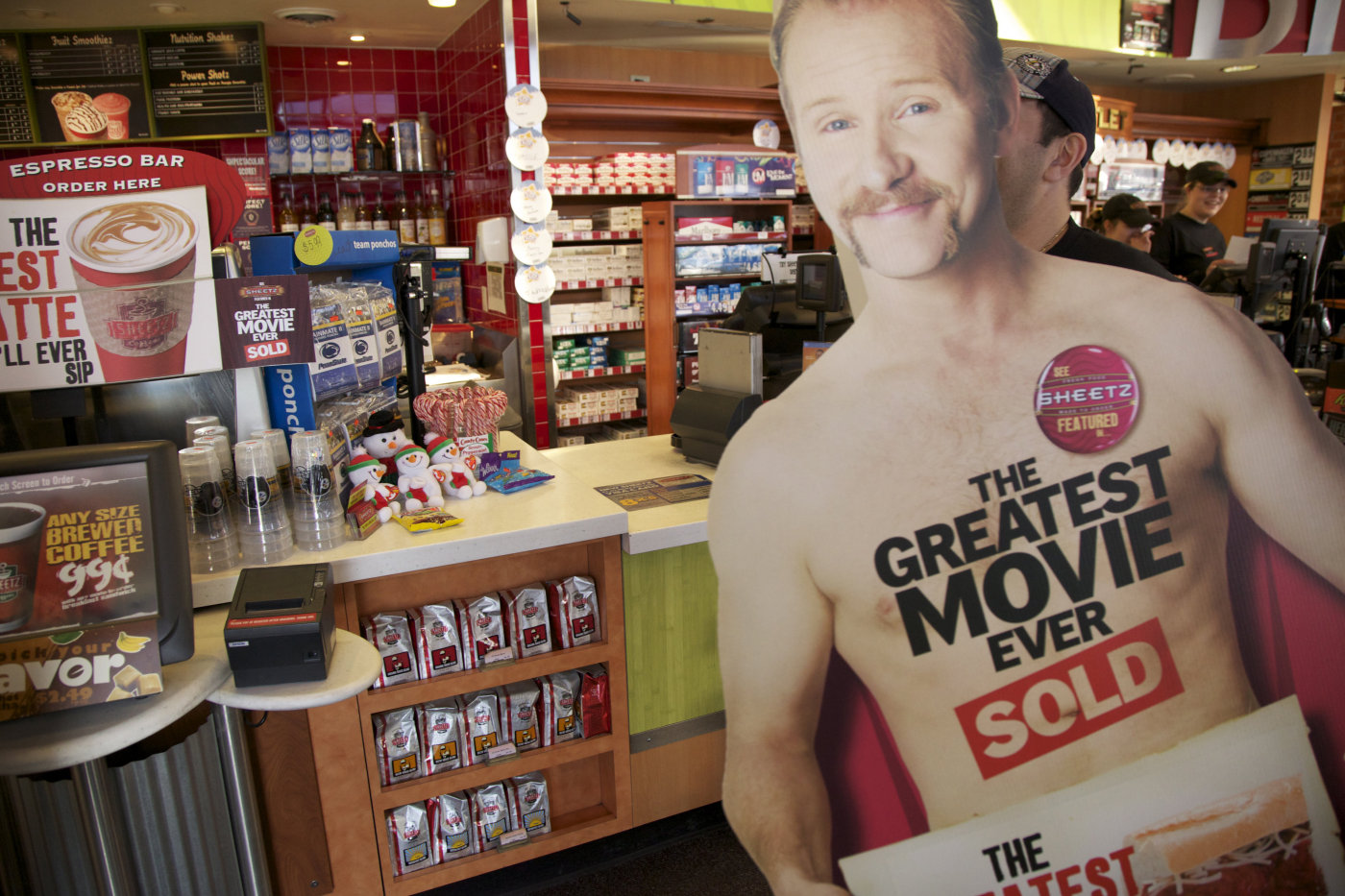
Spurlock did manage to snag a grand total of 22 sponsors, including major sponsor, POM Wonderful – hence the name above the title of the film. Other sponsors include Old Navy, JetBlue and Sheetz, an American convenience store chain that would get Spurlock’s face on collectible soft drink cups, a first for any documentary. Obtaining those contracts make up the first part of the film and, while accomplishing this goal was difficult enough, what would follow would seem even more insurmountable.

Getting in bed with commercial sponsors, which is where every penny of financing for this film came from, means meeting the demands they make in exchange for their large financing contributions. Sure, Spurlock could fly around the country courtesy of JetBlue and could stay at Hyatt’s wherever he went but that meant he had to include actual commercial spots he made himself for these companies in the finished product. And how is this not selling out exactly?

“We pushed back any time anyone wanted approval or final cut of the movie, which ultimately made the film stronger.” This is Spurlock’s rationale for buying in. As long as you are still calling the shots, so to speak, and the movie you make is still your own, then you are buying in, not selling out. “This way it doesn’t feel like a 90-minute commercial.”

Transparency is a key issue for Spurlock and the film’s success. Applied to advertising, transparency allows you to be clearly informed when you are being advertised to. In the context of the film, that application is expanded to shine a light on the entire process in a more extreme fashion. “We pull the curtain back and when the film is over, it changes the way you look at marketing and advertising in the real world.”

And while this is a great feat, accomplished by a great film and filmmaker, there is one other thing Spurlock has noticed on the minds of filmgoers when they’ve finished with THE GREATEST MOVIE EVER SOLD. “When you walk out of the theatre, you also mysteriously have to have a POM right away.”

Money well spent, POM Wonderful, money well spent.

readmore »»